
Key Points
The drama triangle is a simple model that explains recurring conflict patterns between people through three roles—Victim, Rescuer, and Persecutor. We can switch roles quickly in the same conversation. Naming what’s happening and checking in with your needs helps you step out of the cycle.
- The Drama Triangle is a simple model of conflict: roles of Victim, Rescuer, and Persecutor—people can switch fast.
- Spotting your role gives choice; ask what you feel and need right now.
- Try micro-shifts to get out of the triangle: set boundaries, make specific requests, or take a small next step.
What is the drama triangle?
The drama triangle is a psychological model that describes the dynamics of interpersonal conflict in terms of three roles: Victim, Rescuer, and Persecutor. It’s deceptively simple yet incredibly useful for reflecting on how we relate to others.
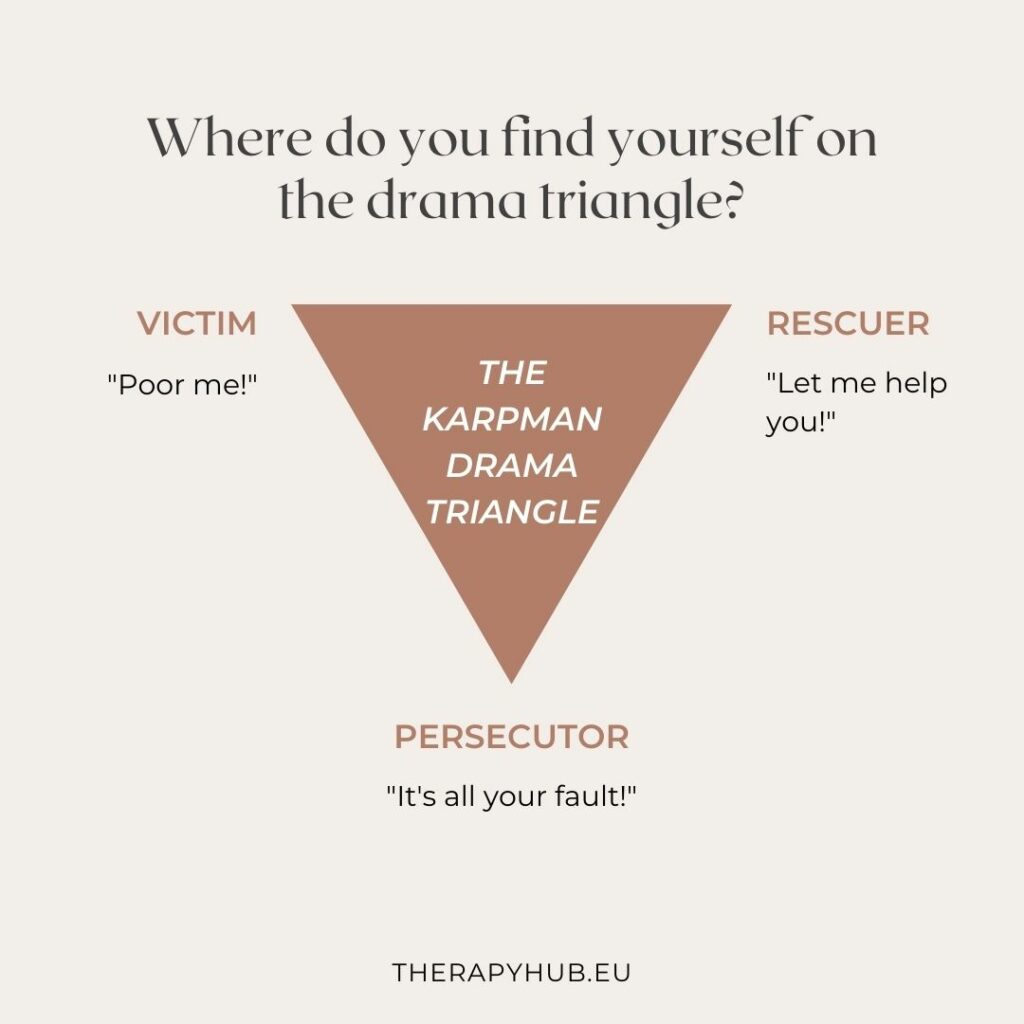
Although the triangle looks static, roles are not fixed. In a single disagreement you might begin as a Rescuer (“Let me fix this”), feel unappreciated and flip into Victim (“No one listens to me”), then lash out as Persecutor (“Why can’t you ever…?”).
Where did the model come from?
The drama triangle was introduced by psychiatrist Stephen Karpman in the late 1960s. His insight: many conflicts follow a three-sided dynamic in which each person unconsciously occupies one of these roles—and can rotate between them.
Why is this useful?
Once you can spot the triangle, you gain perspective on why conversations keep going sideways and what to try instead. Becoming aware of your starting role—often shaped by early experiences—opens up new, healthier responses.
Quick self-check
Ask yourself during tension:
- What role might I be in right now?
- What am I hoping the other person will do for me?
- What do I actually need (from me, from them, from the situation)?
The three roles at a glance
| Role | Core stance | Typical beliefs | Hidden need |
|---|---|---|---|
| Victim | “I’m powerless.” | “Nothing works. Why me?” | Agency & support to act |
| Rescuer | “Others can’t cope without me.” | “I must help to be okay.” | Boundaries & self-care |
| Persecutor | “I must control or correct.” | “People should know better.” | Safety & being heard |
The Victim

In the Victim role we feel powerless—even if we aren’t. Life seems unfair; attempts to change feel futile; self-criticism is high. Shame and anxiety are common companions.
Typical phrases
“No matter what I do, nothing changes.”
“I’m doomed to a life like this.”
“What’s the point in trying?”
“Why does this always happen to me?”
How it shows up
- Deferring decisions to others and then resenting the outcome
- Fishing for rescue or reassurance, then dismissing it
- Quietly keeping score of unfairness
Try this instead (micro-shift)
- Name one choice you still have (even a small one).
- Ask: “What’s one next step that’s 10% doable?”
- Say out loud: “I feel ___ and I need ___.” (Use the feelings wheel to find words.)
The Rescuer

The Rescuer rushes in to help, often to avoid their own discomfort. Focused on others’ needs, they can neglect their own—and feel guilty or resentful when help isn’t welcomed.
Typical phrases
“Don’t worry about me; you’re what matters.”
“I’ve tried everything for her—why won’t she listen?”
“I’m so sorry!” (when no apology is needed)
“I wish I could do more.”
How it shows up
- Solving problems that weren’t asked of you
- Saying yes while quietly feeling overburdened
- Flipping into Victim (“After all I’ve done…”) or Persecutor (“If they’d just do it my way…”)
Try this instead (micro-shift)
- Ask permission: “Would you like ideas or just a listener?”
- Set a boundary + offer: “I can help for 20 minutes; after that I need to get back to X.”
- Check your motive: “Am I helping to reduce my anxiety?”
The Persecutor

In the Persecutor role we manage discomfort by controlling, blaming, or criticising. Empathy narrows; standards harden.
Typical phrases
“Why can no one get things done around here apart from me?”
“How hard can it be?”
“If people weren’t so useless, this would be fine.”
How it shows up
- Barking orders, rolling eyes, sarcasm
- Micromanaging to avoid vulnerability
- Equating disagreement with disrespect
Try this instead (micro-shift)
- Translate blame into specific requests: “By 4pm, please send me X and Y.”
- Reveal one layer underneath anger: “I’m worried about missing the deadline.”
- Swap judgement for curiosity: “What am I not seeing?”
Why it’s hard to see yourself in the triangle
Owning your role means taking responsibility for your reactions—tricky when the relationship feels stuck (workplaces are common hotspots). Start by simply noticing your thoughts about the other person and asking which role you might be casting them in (Victim or Helper/Persecutor). This is a model—not the whole truth about complex human relationships—so hold it lightly.
Stepping out of the drama triangle

Once you notice the pattern, try this simple sequence:
- Pause: take one full breath.
- Name: “I’m in Rescuer/Victim/Persecutor right now.”
- Need: “What do I need in this moment?”
- Ask/Act: make a clear request (of yourself or the other person).
Pro tip: Naming feelings helps. Tools like the feelings wheel can give you language when you’re flooded.
Mini worksheet (save for later)
- My most common starting role is: [ ] Victim [ ] Rescuer [ ] Persecutor
- A recent situation where I noticed it: ____________
- The micro-shift I will try next time: ____________
If you’d like to explore this with a qualified therapist, you can book a free 15-minute consultation to talk it through and plan next steps.
Photos by Shubham Dhage, Jametlene Reskp, camilo jimenez, David Knox, Lindsay Henwood