
Key Points
- The feelings wheel is a practical tool to build emotional awareness by helping you name specific feelings so you can understand them and respond more effectively.
- Originating with Dr. Gloria Willcox in the early 1980s, many versions now exist (e.g., Geoffrey Roberts, Dr Albert Wong, the Gottman Institute, Plutchik, Abby Vanmuijen) with the same core aim: clearer emotion vocabulary.
- How to use it: start from a core feeling and work outward; scan for words you’re drawn to; pick a rarely used word and ask how you know you feel it; or reflect on an event and match the emotions it evoked.
- Identifying feelings is a learned skill for adults and children alike; regular use of a wheel (on your phone/fridge/notebook) strengthens emotional literacy and communication.
Note from William: This article is a popular resource for understanding emotions. If you are exploring your own emotional landscape, particularly as an LGBTQ+ individual, you may find that the focused support of therapy can help you navigate these complexities. You can learn more about my therapy for LGBTQ+ people here.
When we think about how we are feeling, it can sometimes be difficult to connect with the word that best describes how we feel in a given moment.
Indeed, many people are unaware of how they are feeling from moment to moment because they've never been taught the language connected with different feelings and emotions.
The first step towards developing your emotional awareness is identifying your feelings. A feeling wheel can be used as an effective tool for this job.
Emotional awareness is the ability to understand, recognize, and respond to your feelings.
The feelings wheel can be used as an exercise to broaden your emotional vocabulary by helping you identify the moods that you are experiencing.
When you become aware of these emotions, it's easier to find appropriate ways to work with them.
Identifying feelings is a skill you learn rather than something you are born with
Children and adults alike, we all experience emotions.
However, we aren't always aware of them and can't process them healthily.
It's no wonder that we do things we regret when we don't know what we're feeling.
Just like most other abilities, emotional awareness must be learned and practised to develop it over time.
Want to start therapy? Book an initial 15 minute consultation to see if working with me can help bring greater peace and clarity to your life.
What is the feelings wheel?
Originally developed by Dr. Gloria Willcox, back in the early 1980s, the Feelings Wheel was “designed to aid people in learning to recognize and communicate about their feelings” (source).
Since her first version, many others have developed the feelings wheel to contain more terms, fewer terms, different colours, different languages… it's had a lot done to it.
Yet, its essence remains the same: a reference tool that you can put on your fridge, in a notebook, on your mobile phone, or anywhere else that feels convenient, to help you name and communicate how you are feeling in a given moment.
Where can I access the feelings wheel?
There are numerous versions across the internet.
The Feel Wheel by Geoffrey Roberts
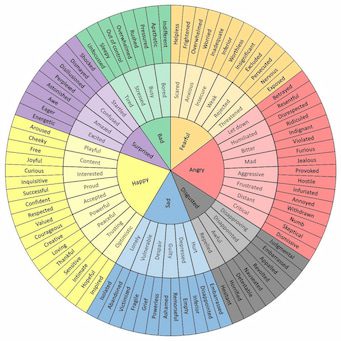
"The Feel Wheel", March 2015, Geoffrey Roberts. This is a low-resolution version of the feelings wheel created by Geoffrey Roberts. The original high-resolution image is no longer publicly available (but can be viewed on Internet Archive here). It is shared here for reference and educational purposes. If a new official source becomes available, this page will be updated accordingly.
This version of the feelings wheel, called the Feel Wheel, was created by Geoffrey Roberts. It presents a structured way of identifying and naming emotions, beginning with broad core feelings in the centre and branching out into more specific related emotions. The design is both visually clear and widely used in educational, therapeutic, and self-reflection contexts. While other versions have since been created, this one is valued for its simplicity and accessible layout.
Emotions Wheel by Dr Albert Wong
The Feelings Wheel, or Emotion Wheel, by Dr Albert Wong also starts with seven core emotions and uses colour to distinguish the different starting points. However, a key difference here is the focus on feelings rather than reactions.
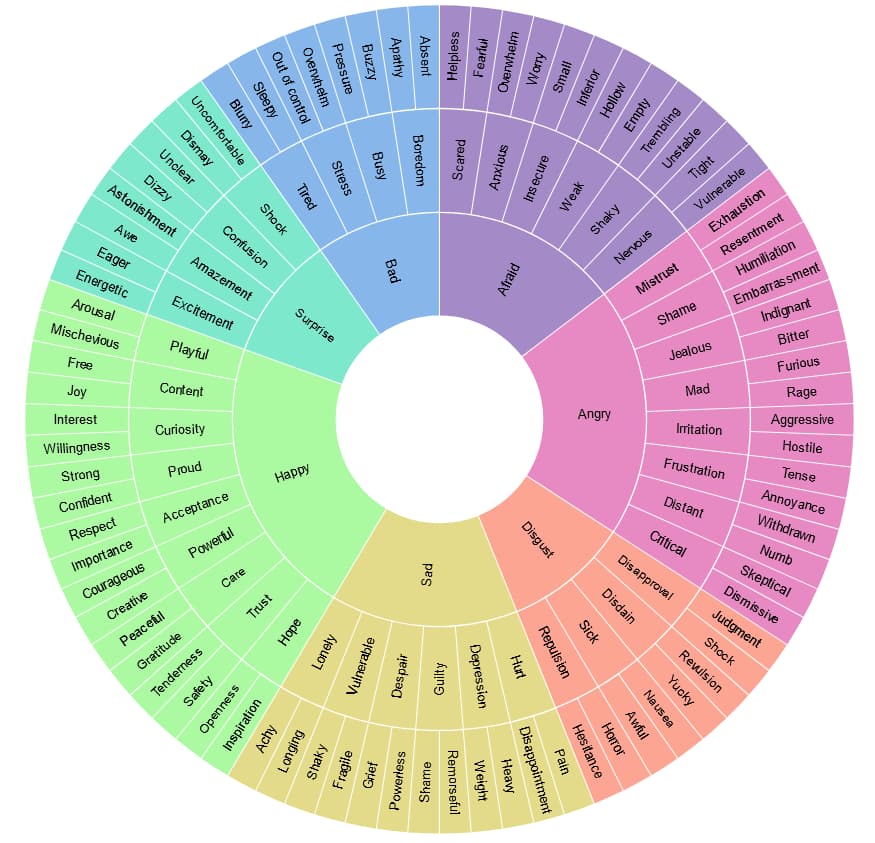
"The Feelings Wheel", Albert Wong (2019)
This version of the Feelings Wheel was developed by Albert Wong, who reworked the structure and visual presentation to emphasise clarity and a focus on feelings, rather than stories about things that might be happening (but are not, in fact, feelings). It retains the core idea of expanding from central emotions to more specific ones. You can read more about the reasoning and design choices behind it in his 2019 post: https://observablehq.com/@ajwwong/feeling-wheel
The Gottman Institute's Feeling Wheel
The Gottman Institute, founded by renowned relationship psychologists Drs John and Julie Gottman, has developed its own version of the feelings wheel. Their version begins with six core emotional categories rather than the more typical seven. These form the basis from which related feelings branch outward.
You can download a PDF version of the wheel from their website: https://www.gottman.com/blog/printable-feeling-wheel/
Plutchik's Wheel of Emotions
Psychologist Robert Plutchik's version organizes emotions into eight primary categories, including joy, trust, fear, surprise, sadness, disgust, anger, and anticipation. Each primary emotion is further divided into nuanced variations, creating a spectrum of human feelings.
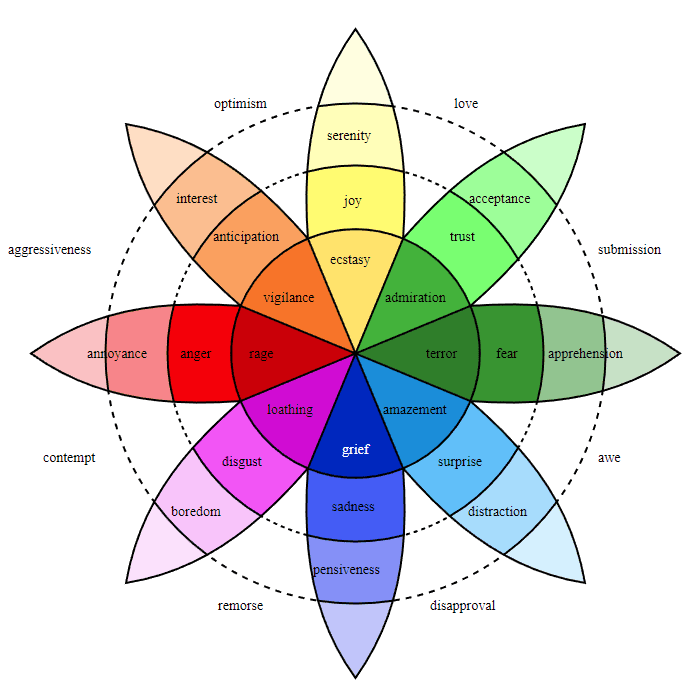
Robert Plutchik's Wheel of Emotions by Wikimedia Commons user Machine Elf 1735
The wheel provides a useful tool for understanding and exploring the complex range of emotions that individuals experience, offering insights into the interconnectedness and intensity of different emotional states. With its visually appealing design and comprehensive categorization, Plutchik's Feelings Wheel has become a valuable resource in various fields, including psychology, therapy, and creative expression.
Emotion Wheel by Abby Vanmuijen
Abby Vanmuijen, an artist based in California, created a captivating artwork that uses watercolour techniques to depict a wide range of human emotions. The wheel is divided into different colours, each representing a specific emotion.
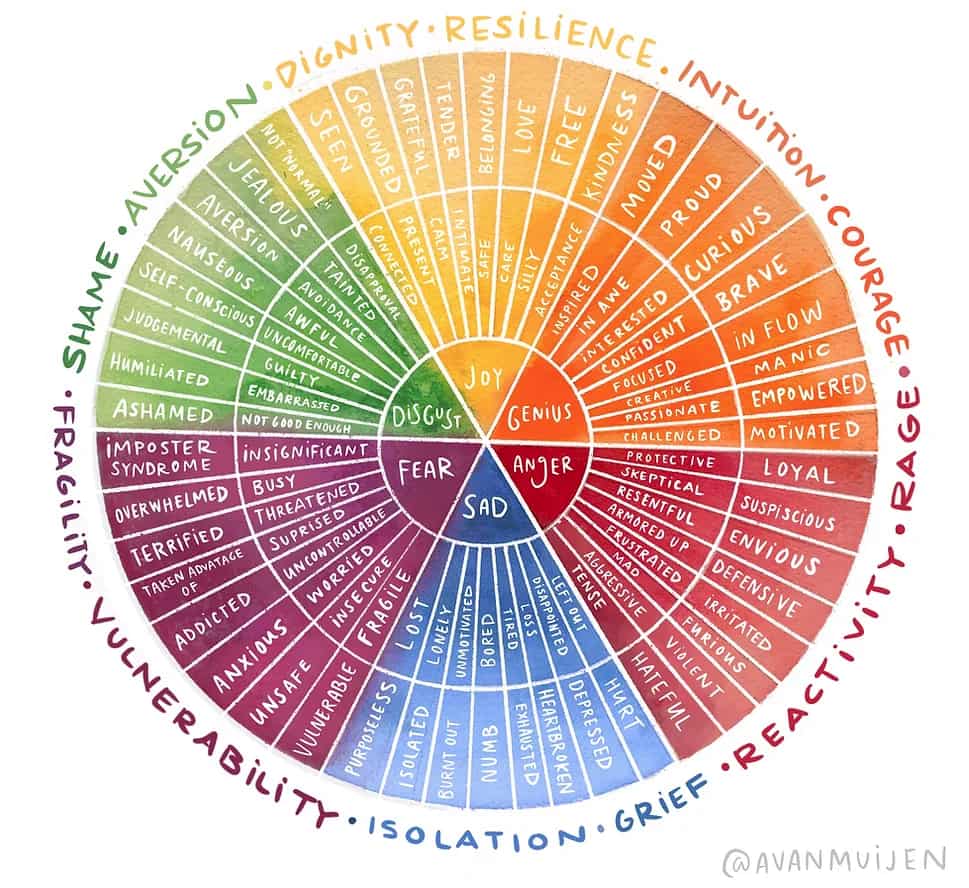
With its vibrant and engaging design, Abby Vanmuijen's emotion wheel provides a visually appealing way to delve into the complexities of human emotion. Abby offers the Emotion Wheel and other feelings art as free downloads or prints that can be purchased at: https://www.avanmuijen.com/watercolor-emotion-wheel
How to use the feelings wheel to identify your emotions
The feelings wheel is a tool for people to learn how to identify their feelings, understand them better, and deal with them more effectively.
You can use the feelings wheel in a few ways.
-
Start from the centre, identifying an emotion, and then work outwards from there to find another word or words that better describe how you feel
-
Scan the wheel, noticing which words you are drawn to more than others
-
Look around the wheel and begin to focus on a particular word, perhaps one that you rarely use, and ask yourself, “how do I know when I am experiencing this feeling?”
-
Think back to an even that you enjoyed and use the words on the feels wheel to help explain the emotions you felt that made it enjoyable
Talking to a qualified online counsellor can be helpful if you struggle to make use of this resource on your own.
If you have other suggestions for how to use this tool, please post them in the comments!
Example Scenario: Understanding Complex Emotions with the Feelings Wheel
Let's imagine that John had a tough day at work. He comes home feeling “bad”, but “bad” is a broad term and doesn't give John a clear understanding of his emotions or how to address them. Here's how John might use the feelings wheel:
-
Identify the Core Feeling: John starts by recognizing that he feels “bad”. In the context of the feelings wheel, this could translate to a core emotion like “sad”.
-
Explore More Specific Feelings: He then looks at the feelings wheel, starting from “sad” and working his way outward. As he reflects on his day, he realises he was left out of an important meeting. This exclusion makes him feel “lonely”.
-
Dive Deeper: Continuing to explore the feelings wheel, John identifies that he also feels “guilty” because he didn't speak up about being left out of the meeting. He also acknowledges feelings of “shame” for not being considered in the first place.
By using the feelings wheel, John has moved from a vague sense of feeling “bad” to identifying specific emotions: “lonely,” “guilty,” and “ashamed.”
This clarity allows him to better understand his emotions and can guide him in addressing these feelings. For instance, he may decide to communicate his feelings to his colleagues or seek advice on how to assert himself at work.
In this way, the feelings wheel has helped John to develop his emotional awareness and provides a starting point for managing his feelings in a healthier and more effective manner.
For a deeper exploration of how life experiences like minority stress can shape these complex feelings of loneliness or shame, you can continue reading A Guide to Gay Self-Acceptance & Navigating Minority Stress.
FAQs about the Feelings Wheel
What is emotional awareness?
Emotional awareness is the ability to understand, recognize, and respond to your feelings. It's a skill that can be learned and developed over time, just like most other abilities.
What is the feelings wheel?
The feelings wheel is a tool originally developed by Dr. Gloria Willcox in the early 1980s. It's designed to help people recognize and communicate about their feelings. The essence of the feelings wheel remains the same despite various versions existing, with more terms, fewer terms, different colours, and different languages. It can be used as a reference tool in various locations, such as on your fridge, in a notebook, or on your mobile phone.
Where can I access the feelings wheel?
There are numerous versions of the feelings wheel available across the internet. Some versions include "The Feel Wheel" by Geoffrey Roberts, "Emotions Wheel" by Dr Albert Wong, "The Gottman Institute’s Feeling Wheel", "Plutchik’s Wheel of Emotions", and "Emotion Wheel" by Abby Vanmuijen. They can be accessed through their respective links or purchased as prints.
How can I use the feelings wheel to identify my emotions?
There are several ways to use the feelings wheel. You can start from the centre, identifying an emotion, and then work outwards from there to find words that better describe how you feel. Alternatively, you can scan the wheel, noticing which words you are drawn to more than others, or focus on a particular word, perhaps one that you rarely use, and ask yourself how you know when you're experiencing this feeling. Another approach could be to think back to an event that you enjoyed and use the words on the feelings wheel to help explain the emotions you felt that made it enjoyableRevisit the full guide to using the feelings wheel.
Why should I use the feelings wheel?
Many people struggle with finding the right word to express how they are feeling at a particular moment. The feelings wheel can help develop your emotional awareness by offering more choices than common terms like 'OK', 'sad', 'alright' or 'angry'. Developing emotional literacy doesn't happen overnight, but taking small steps, like referencing a copy of the wheel on your phone every so often, can be a positive step towards communicating how you really feel in a given moment.
What if I struggle to use the feelings wheel on my own?
It can be helpful to talk to a qualified online counsellor if you're finding it difficult to use the feelings wheel on your own. They can guide you through the process of identifying and understanding your emotions more effectively.
Can I use the feelings wheel with children?
Yes, the feelings wheel can be a great tool to help children identify and understand their emotions. Since emotional awareness is a skill that can be learned and developed over time, introducing the feelings wheel to children can provide a strong foundation for their emotional literacy.
Can I create my own feelings wheel?
Absolutely. While there are many versions of the feelings wheel available, you're always free to create your own, customising it to better suit your personal understanding and expression of emotions. The main goal of the feelings wheel is to assist in recognising and communicating feelings, so if creating your own helps facilitate this, it could be a beneficial exercise.
Is the feelings wheel a form of therapy?
The feelings wheel isn't a therapy in itself, but it's a tool that can be used in conjunction with therapy or counselling. It can help individuals to better understand their emotions and communicate them effectively, which is often an important aspect of therapeutic processes.
Summary
Many people struggle with finding the right word to express how they are feeling at a particular moment, usually because emotional education is rarely taught at schools or at home.
The feelings wheel is a way of helping you to develop your emotional awareness by offering up many more choices than 'OK', 'sad', 'alright' or 'angry'.
Developing emotional literacy doesn't happen overnight, but taking small steps, like putting a copy of the wheel on your phone to reference every so often, can be a positive step towards communicating how you really feel in a given moment.
Photo by Nick Page